What Is APPR, and Why Does It Exist?
APPR stands for Annual Professional Performance Review. It’s the system New York State uses to evaluate teachers and principals — a structured framework that determines how educators are observed, rated, and supported based on their professional performance.
New York has required formal educator evaluation since 2010, and the system has been amended several times since then. APPR in place today was significantly shaped by Education Law 3012-d, enacted in 2015. Under 3012-d, districts were required to rate educators on a four-level scale — Highly Effective, Effective, Developing, or Ineffective (the HEDI scale) — using a combination of classroom observations and student learning objectives (SLOs), with weights prescribed by the state. There is a heavy reliance on standardized assessment scores.
The basic idea behind APPR is sound: teaching is a profession, professionals should be evaluated, and evaluation should drive growth. The debate has always been about how to do it well.
What’s Wrong With the Current System?
Honest answer: quite a bit, depending on who you ask. The complaints about 3012-d have been consistent and widespread across districts of all sizes and demographics:
- The observation workload is unsustainable — every educator, every year, no exceptions
- Student Learning Objectives tied to state assessment scores create equity problems and feel disconnected from the work of many educators
- The prescribed weighting system (60% observations, 20% SLOs) doesn’t reflect local priorities or context
- Educators who don’t teach tested subjects — art, music, PE, counselors, CTE instructors — have always felt poorly served by a system built around standardized test data
- The administrative burden has grown to the point where it actively competes with instructional leadership time
These aren’t fringe complaints. They’re the lived experience of building principals, assistant superintendents, and union leaders across New York State. And they’re exactly what the new legislation is designed to address.
Worth knowingBoth educator unions (NYSUT) and management organizations have broadly supported the transition to 3012-e, which is relatively rare in education policy. That consensus reflects how widely felt the problems with the current system have been.
Enter 3012-e: The STEPS Framework
Chapter 143 of the Laws of 2024, signed June 28, 2024, establishes Education Law 3012-e — the Strengthening Teaching and Elevating the Profession of School Leaders (STEPS) framework. It doesn’t eliminate APPR. It replaces the specific structure of 3012-d with a more flexible, locally driven approach that keeps the core accountability framework intact while giving districts meaningful room to design evaluation systems that actually fit their communities.
All LEAs must adopt a compliant STEPS plan by June 30, 2032. Districts may begin transitioning now, and many have compelling reasons to do so ahead of the deadline.
What Actually Changes Under 3012-e?
Here’s a side-by-side look at the most significant differences:
| 3012-d — Current APPR | 3012-e — STEPS |
|---|---|
| Observation cycleFull observation cycle required annually for every educator, tenured or not | Observation cycleMulti-year cycles permitted for tenured educators (up to 3 years); probationary staff and those at the two lower rating levels remain on annual cycles |
| Growth measureStudent Learning Objectives (SLOs) based primarily on state assessment data | Other measureChoice from NYSED suggested/sample measures or locally designed instruments aligned to standards — portfolios, surveys, goal setting, peer observation, and more |
| Component weightsState-prescribed: 60% observations, 20% SLOs — no flexibility | Component weightsLocally negotiated — districts set their own weighting through collective bargaining |
| State aid linkTied to state aid apportionment through the APPR process | State aid linkNo state aid apportionment requirement |
| Standards alignmentImplicitly aligned to NYS Teaching Standards through rubric design; no explicit standalone plan requirement | Standards alignmentExplicit requirement — every measure, rubric, and cycle design must be documented as aligned to NYS Teaching Standards (teachers) or PSELs (principals) |
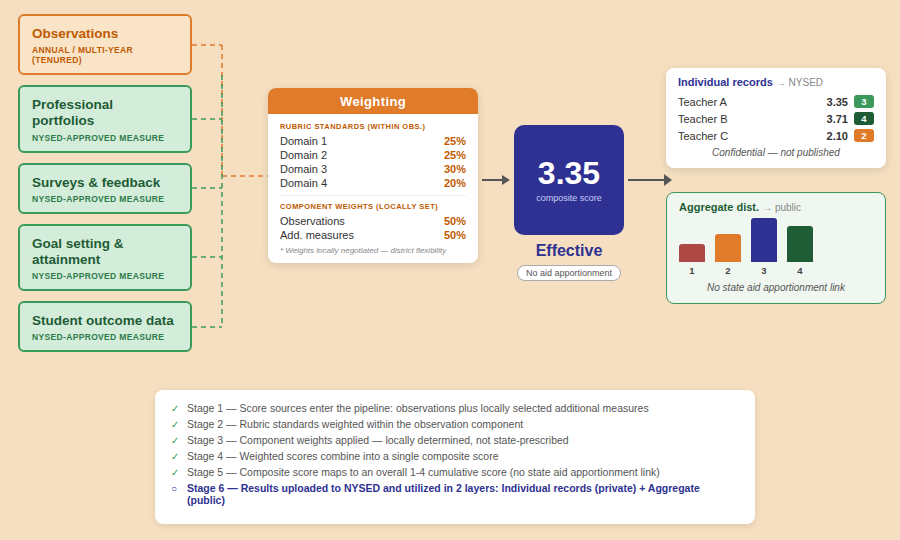
| Scoring modelSeparate HEDI rating for Obs and SLO, then combined via state-prescribed matrix into a single overall HEDI rating | Scoring model1–4 score on each NYS Teaching Standard, then a locally determined overall rating — no state matrix |
| ReportingObs score, SLO score, and overall HEDI. Individual records confidential; aggregate distributions published. | ReportingScore per NYS Teaching Standard plus an overall rating — organized by standard, not by component. Individual records confidential; aggregate distributions published. |
| Observation rubricMust use a NYSED-approved rubric (Danielson, Marshall, Marzano, NYSUT, etc.) | Observation rubricNo state-mandated rubric — any rubric demonstrating alignment to NYS Teaching Standards or PSELs is acceptable |
| Annual overall ratingEvery educator receives an annual overall HEDI rating | Annual overall ratingProbationary educators: annual. Tenured educators: overall rating issued at end of cycle (up to 3 years), not necessarily annually |
The Two Biggest Structural Changes in 3012-e
1. Standards Alignment Is Now the Organizing Principle
This is one of the most significant structural departures from 3012-d. Under 3012-d, alignment to the NYS Teaching Standards (for teachers) and the Professional Standards for Educational Leaders (PSELs) (for principals) was implicit — assumed to exist through the design of approved observation rubrics, but never explicitly documented or verified at the plan level.
Under 3012-e, that changes completely. Standards alignment is not a formality — it is the organizing principle of the entire framework. Districts must affirmatively demonstrate in their STEPS plan how every measure, rubric, and cycle design choice connects to specific standards. Every evaluation decision flows from the standards, and NYSED will review plans for this alignment before approving them.
2. The Scoring Model Is Fundamentally Different
3012-d — Matrix Model
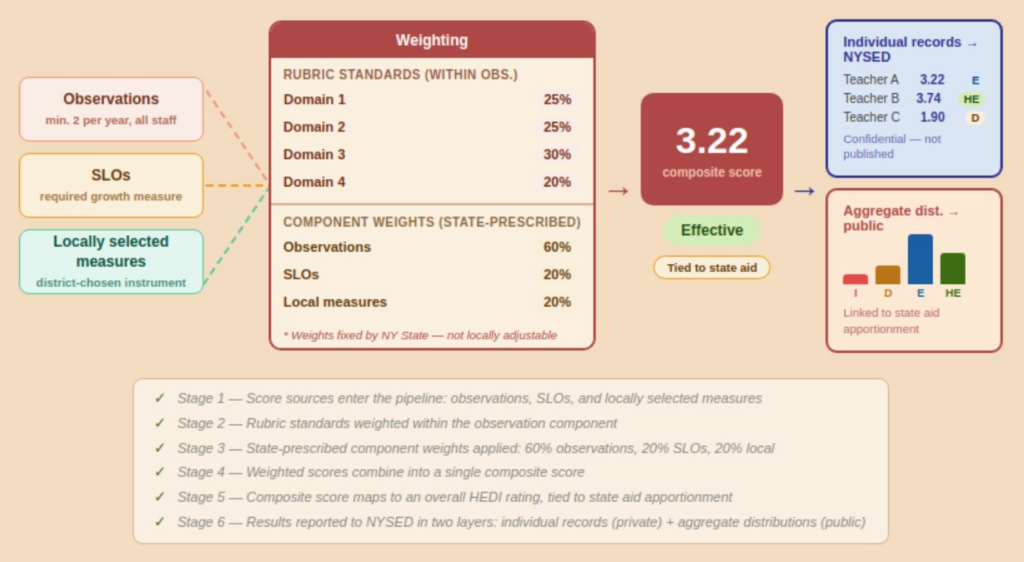
2 component scores → 1 overall via state matrix. Rigid, sometimes counterintuitive outcomes.
3012-e — Standards-Based Model
What Stays the Same?
The core architecture of educator evaluation in New York doesn’t go away:
- Classroom observations are still required — the cycle length may change for tenured staff, not the expectation of being observed
- Probationary educators still receive an annual overall rating and require full annual observation cycles
- Individual records are still submitted to NYSED and remain confidential
- Aggregate distributions are still published publicly
- Educators at the two lower rating levels still require annual cycles regardless of tenure status
One significant change worth noting separately: under 3012-d, districts were required to use a NYSED-approved observation rubric. Under 3012-e, that requirement is gone. Districts may still choose to use Danielson, Marshall, Marzano, NYSUT, or any other rubric — and many will — but they are equally free to develop or adopt any rubric that demonstrates alignment to the NYS Teaching Standards. The state no longer dictates the instrument; only the standards it must address.
The Eight NYSED Suggested/Sample Additional Measures
One of the biggest practical changes for districts is replacing SLOs with a menu of additional measures. NYSED has published eight suggested/sample measures as starting points — these are not exhaustive or mandatory. Districts may propose other measures through their STEPS plan as long as they align to the standards. All measure selection is determined through collective bargaining.
- Professional Portfolios — educator-compiled collections of lesson plans, student work, and professional development reflections
- Surveys & Feedback — structured input from students, parents, or peers
- Goal Setting & Attainment — individual educator goals with documented progress and outcomes
- Student Outcome Data — includes achievement goal setting, performance index, assessment scores, and statistical growth measures
- Portfolios of Student Work — collections measured by a state-approved or locally developed rubric
- Teacher / Principal Projects — structured professional projects aligned to NYS Teaching Standards or PSELs
- LEA-Developed Measures — locally designed instruments created by your district or BOCES
- Peer Observation — observations conducted by trained peers, mentors, or instructional coaches
What Do Districts Need to Do to Transition?
The transition to 3012-e isn’t automatic — it requires deliberate planning, collective bargaining, and NYSED approval. Here’s the general sequence:
Common Questions From District Leaders
Yes — and many districts have good reasons to move sooner. Early adoption allows you to begin realizing the workload benefits of multi-year cycles and to get ahead of the collective bargaining timeline before the deadline creates pressure.
No. Multi-year cycles for tenured educators are permitted, not required. A district can choose to keep annual cycles for all staff if that’s what is agreed upon through bargaining.
No — this is one of the more significant changes. Under 3012-d, districts were required to use a NYSED-approved rubric. Under 3012-e, that requirement is eliminated. You may continue using any rubric your district values, but you are equally free to use or develop any rubric that aligns to the NYS Teaching Standards. The state approves the standards; you choose the instrument.
Not necessarily — this is an important distinction from 3012-d. Probationary educators must be evaluated on all standards and receive an overall rating every year. Tenured educators must be evaluated on all standards across their cycle, but may be evaluated on a subset of standards in any given year, with the overall rating issued at the end of the cycle (up to 3 years). Nothing in the regulation prohibits districts from designing their plan to issue annual overall ratings for tenured staff if they choose.
Those educators remain on annual observation cycles regardless of tenure status. The multi-year cycle option applies only to tenured educators who are not at the two lower overall rating levels.
Yes. Measure selection, component weighting, and multi-year cycle design must all be collectively bargained with both teacher and principal unions before your plan can be submitted to NYSED.
That depends on your current platform. Districts should verify that their system supports multi-year cycle scheduling, the full range of additional measures, per-standard scoring, overall rating generation at the end of multi-year cycles, and the updated NYSED reporting requirements. Not all platforms are ready for 3012-e — and readiness means more than compliance; it means actively enhancing the quality and efficiency of your evaluation process.
The Bottom Line
APPR isn’t going away — it’s growing up. The STEPS framework under 3012-e keeps the accountability infrastructure that New York has built over the past decade while giving districts the flexibility to make evaluation actually work for their educators and their communities. That’s a meaningful shift, and it deserves a thoughtful transition.
The districts that will benefit most are the ones that start planning now — not because the deadline is close, but because the benefits of a well-designed STEPS plan are real and available today.
NY State Education STEPS (3012-e) Guidance Documents →
RightPath™ is ready for 3012-e
Our evaluation platform supports multi-year observation cycles, all NYSED sample additional measures, per-standard scoring, overall rating generation across multi-year cycles, and complete STEPS plan documentation — plus the observation scheduling, rubric tools, and reporting your district already relies on. We’ve been supporting NY districts through every evolution of APPR, and we’re ready to help you navigate STEPS.
As a bonus, we also support world-class evaluation of non-educator staff such as transportation, nursing, clerical, nutrition, technology, security, and more.
Next: How STEPS 3012-e Additional Measures Improve Educator Evaluations →
Download this Plain-Language Guide (PDF) to share with colleagues→