Learning Gaps
Identify and Close the Gaps - Easily, and Efficiently
Closing Learning Gaps
Whether you prefer to use the term "delayed learning" or "learning gaps,"
it is undeniable that the last 2 years have had a negative impact on student learning.
There is considerable research that shows that once a student has fallen 2 academic years behind, normal in-class remediation is insufficient to reverse the trend towards academic failure and ultimately dropping out of high school. Because of this, we see an extreme need for more programs that offer personalized learning opportunities, given through direct instruction.
In addition to the stressors all of us have been dealing with:
- Students have been forced to adapt their learning style to changes in course delivery
- Teachers have had to hurriedly migrate their learning resources from on-site to remote delivery or learn complex tools at home and without sufficient PD
- Students have had to learn remotely with little or no supervision due to parental employment requirements
- Teachers have had less ability to assess student learning
- Students have had to help siblings while sharing their remote learning space
- Inequities in resources have exacerbated challenges for students already disadvantaged by economic stresses
- Tier 1 instruction has been challenging, Tier 2 & Tier 3 nearly impossible
Learning gap identification is particularly difficult now because it doesn't follow the intuitive patterns that we expect.
Students who in the past have excelled, or at least been able to manage proficiency, are struggling under the current circumstances.
Students whose learning style is best supported through traditional lecture model instruction and who in the past generally did not require remediation, are quietly struggling.
Distractions of all kinds, including short- and long-term technical challenges and absences, are causing patterns of learning loss in places that we used to be able to assume would be fine.
The only way to help students work their way out of elusive learning gaps is with formal remediation that is data-informed and where instruction is individualized as much as possible. It's also necessary to continue with on-grade level instruction.
The best method to close the gaps is an expanded Data Informed Instruction AIS/RTI/MTSS program for the large number of students affected by COVID.
Steps to proficiency & Mastery
RightPath™ provides a comprehensive data analysis and reporting system created by educators for educators. Our system monitors achievement while identifying strengths and targeting areas in need of improvement, giving yet another benefit of individualized instruction. Our multi-level instructional reports provide macro and micro views of your district, school, class, and individual students. RightPath™ offers a substantial and varied menu of assessment choices to meet your needs. RightScore ensures timely scoring and feedback when delivering assessments online or on paper. RightPath™ has all the tools you need to monitor student progress and promote their growth, while they move towards mastery. The data analysis of a personalized learning environment will allow you, as an educator, to properly identify exactly what your students need.
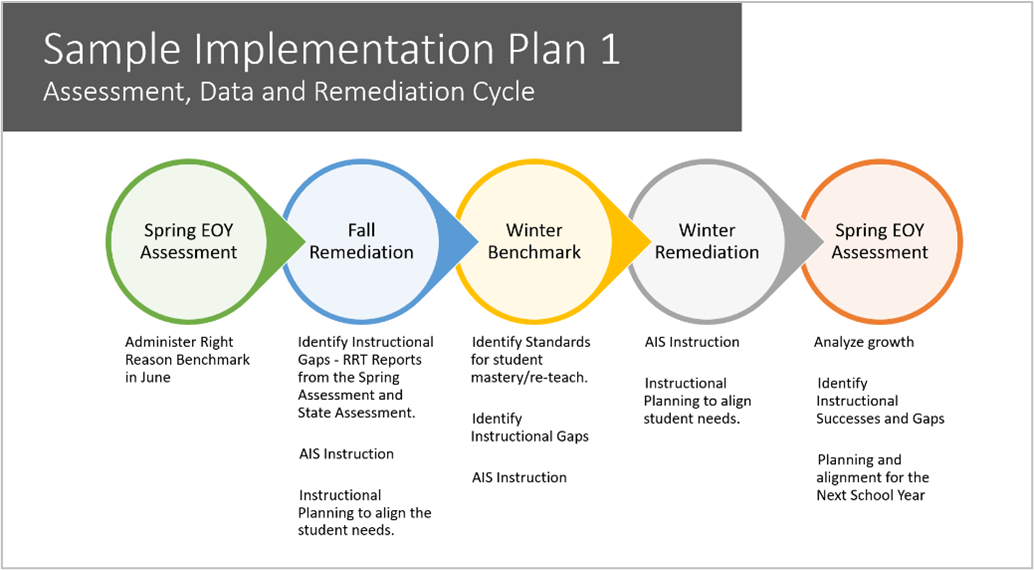
Sample Benchmark Cycle
Our Benchmarks or Yours
Instructional Reporting -
“Know where your students are”
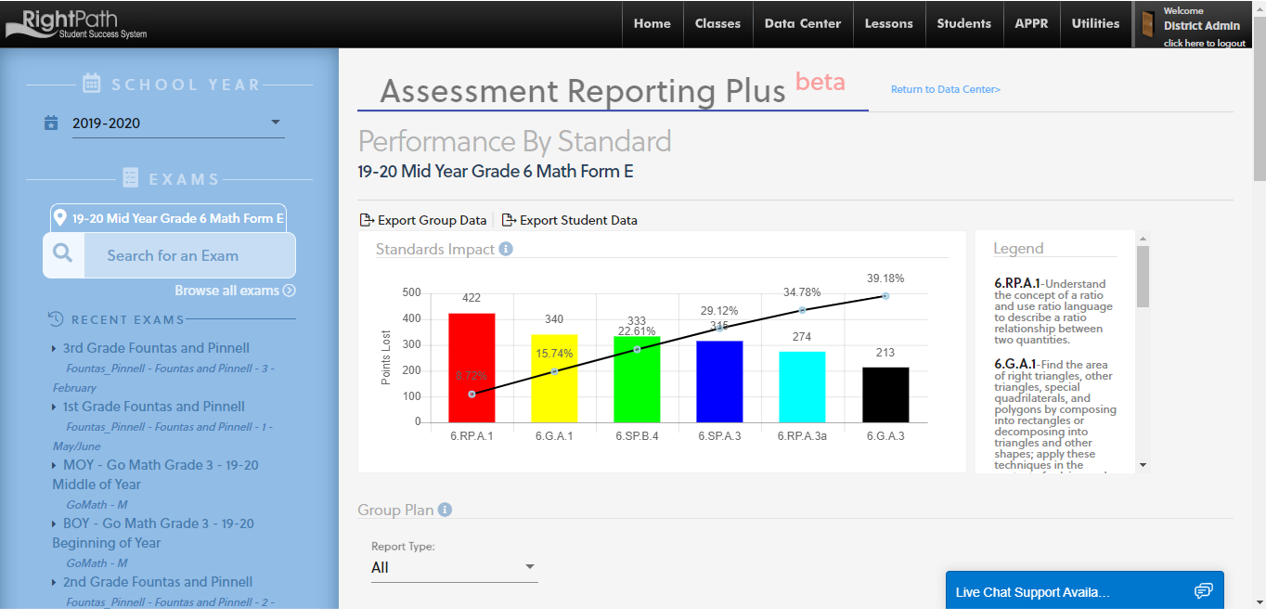
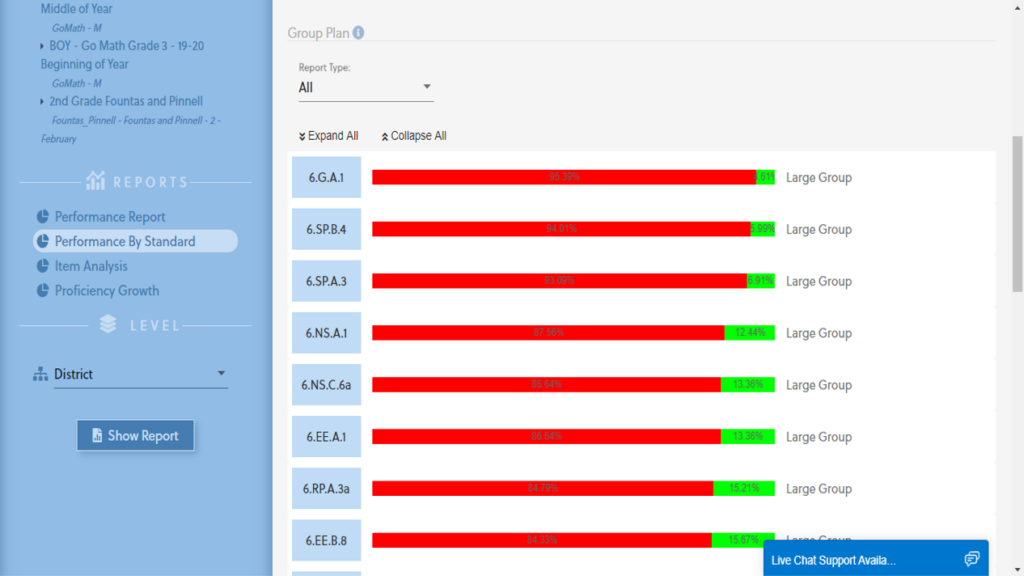
Utilize data from any standards-based assessment to identify strengths and weaknesses in proficiency and mastery. Both graphical and written feedback provides insight into what is really going on as your students navigate towards mastery. Use our assessments, your local assessments or 3rd party assessments.
- Performance By Standard
- ID Chart – Prioritize instruction based upon real results from students. Target specific instruction in priority order for only those that require it.
- Individual students
- Small group
- Whole group
- Item Analysis
- Review assessment responses question-by-question to see how effective the distractors were and if there is a pattern of learning gaps by standard. Get recommendations for lessons to remediate based upon incorrect responses.
- Rank Order - Rank students based upon assessment performance outcomes
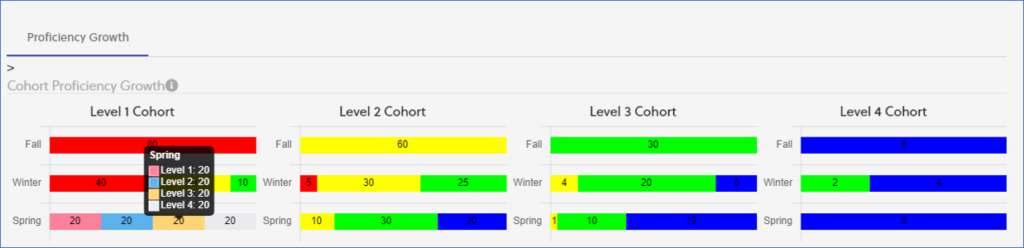
- Proficiency Growth – Compare the outcome of 2 or 3 Benchmark assessments to evaluate the growth of those populations - entire district, building, all of a teacher’s classes or a single class. Visually compare proficiency growth as they progress though their learning journey.
- ID Chart – Prioritize instruction based upon real results from students. Target specific instruction in priority order for only those that require it.
How could RightPath™ Stepping Stones also help?
RightPath™ has always provided insights into student learning gaps...
How is this different?
In addition to identifying strengths and weaknesses in proficiency specifically identified with an assessment, educators can now review associated building block standards through the employment of coherence mapping.
From an assessment:
In the concept representation below, the assessment identified issues with the standard in green - 4.0A.A1.
Moving to the left, connects us to the building blocks 3.0A.A.1, 3.0A.A.3,and deeper to 2.0A.C3, 2.0A.C.4 and 3.0A.A.2.
Moving to the right the system recognizes that our "tested standard" 4.0A.A1 is a building block to both 5.NF.B.3 and 5.NF.B.6!
Curriculum or Lesson Management:
These highly effective insights can also be helpful from a curriculum or lesson assignment perspective.
When working on curriculum or assigning lessons to students from a curriculum or lesson bank, building block coherence can be used as a guide.