Most administrators running CTE pathways, UPK programs, or school choice enrollment already sense that their current process isn’t built for what compliance actually requires. The spreadsheet tracks the applications. The email chain tracks the follow-ups. Someone’s memory tracks the lottery. And somewhere in that arrangement is an audit trail that doesn’t exist.
The question isn’t whether the process has gaps. It’s whether those gaps create exposure — and in New York, they do.
The answer is almost never a staffing problem or a budget problem. It’s a design problem. The tools most districts are using to manage program coordination were never built for what program coordination actually requires — and the gap between what the process demands and what the tools can deliver grows every time you add a building, a program type, or a BOCES partnership.
The Challenge Starts Simple
Think about the simplest version of the problem: a student completes a CTE exploratory course and applies to a high school pathway. Somebody needs to match that application to the student’s school record. Who does it? How? In what system?
In most districts, the honest answer is: paper files held centrally, a spreadsheet, an email chain, or whoever remembers. It’s unglamorous, but it holds together — for a while, at a small enough scale.
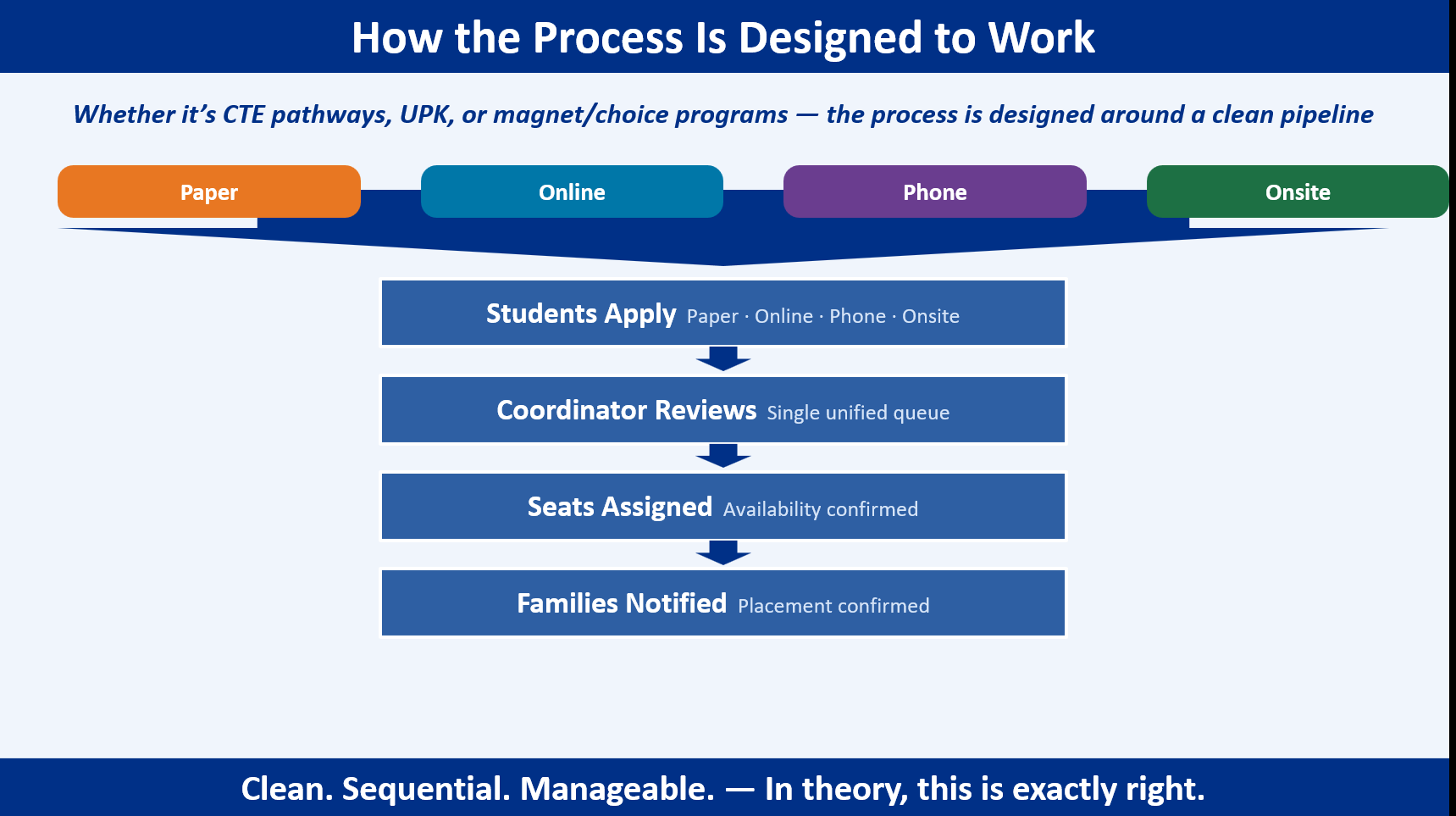
Now multiply it. Four middle schools running exploratory programs. One or two high schools managing pathways. A BOCES partnership feeding in from the side. Each source feeds differently. Each has its own tracking. The coordinator is managing four or more separate processes, none of them connected, with no reliable way to validate that an application aligns with where the student actually came from.
WORTH NOTING
The solutions that barely work at one cohort’s scale won’t survive the next one. And in New York, the stakes of getting it wrong aren’t just operational — they’re regulatory.
What Actually Happens When Applications Come In
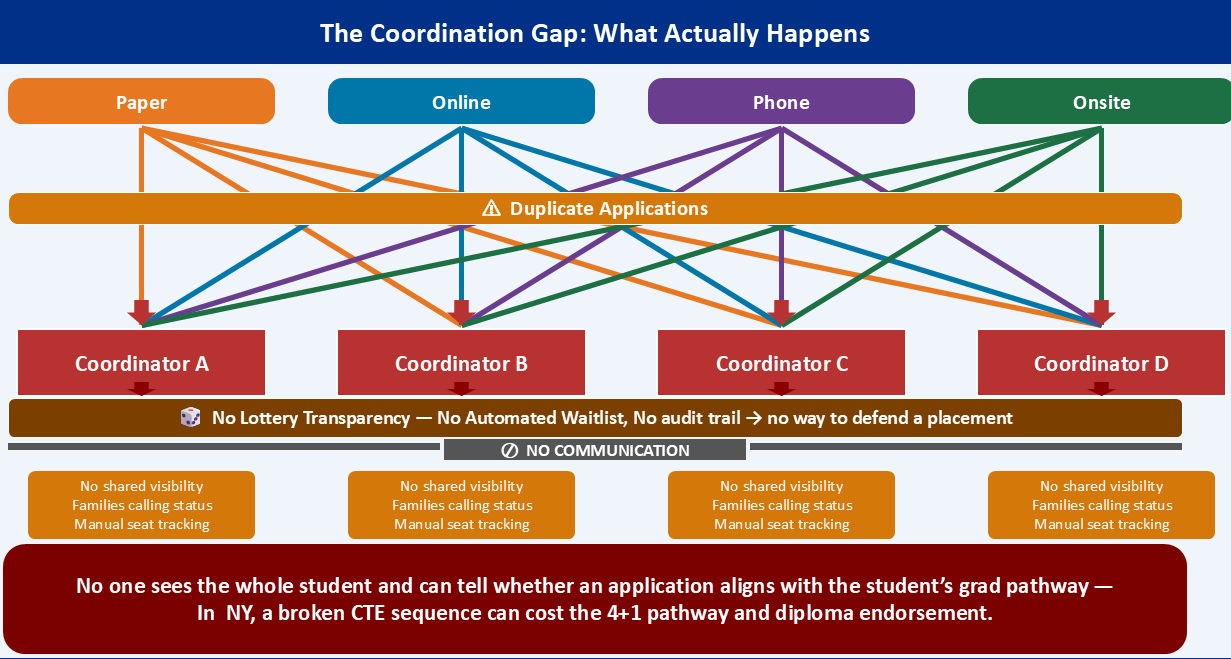
Applications arrive through multiple channels — paper, online portal, phone, walk-in — and any coordinator can receive any one of them. You may plan for families to apply online. But when the phone rings and a student is asking about a CTE program, someone takes that call. When a family walks into their child’s guidance counselor and asks how to apply, that counselor finds a way to help. In most schools, no matter how carefully you design the intake process, applications will come in through more than one door — and when they do, there is no shared view of who has applied, who is pending, or where each application stands. Each coordinator is working from their own queue, their own spreadsheet, their own memory of what came in and when.
The result is predictable: duplicate applications from families who weren’t sure their first submission went through. No lottery transparency — families have no way to see whether the process was fair, let alone verify it. No automated waitlist — when a seat opens, someone has to remember to call. No audit trail to answer the question every coordinator dreads: Why wasn’t our child selected?
Fragmented. Redundant. Unscalable.
Every coordinator works in isolation. Every family navigates it alone.
LOTTERY LIABILITY: WHAT’S AT STAKE IN NEW YORK
For oversubscribed UPK programs, a random lottery isn’t a best practice — it’s a legal requirement. Under Commissioner’s Regulations §151-1.4(d), New York districts must use random selection when eligible applicants exceed available seats. And under Education Law §3602-e, lottery results cannot be adjusted for any demographic — not for income, not for language, not for any other factor, however well-intentioned.
Running an informal or manual lottery creates three specific liabilities:
- You can’t prove randomness. If a family challenges a result, “we put names in a hat” is not a defensible answer.
- You can’t prove it was unadjusted. Any informal step in the process — a well-meaning exception, a late application accepted — can look like manipulation after the fact.
- You have no documented waitlist. Non-selected families must be placed on a waitlist in lottery order. Without a system record, that order doesn’t exist.
A closed, auditable transparent lottery system doesn’t just satisfy the requirement — it’s the only way to show a family, a board member, or a compliance reviewer exactly how the draw was conducted, who was selected, and where every non-selected child stands on the waitlist.
Four Pain Points That Multiply With Scale
No visibility across coordinators and buildings. Information lives in silos — paper trails, multiple spreadsheets, separate SIS records for exploratory courses, separate systems for applications. Coordinators manually piece together eligibility, often working from incomplete data.
Manual seat tracking is a single point of failure. One person holds the master count. When they’re out, the process stops. Knowledge that should be institutional stays personal. Or worse: multiple people across multiple buildings are each maintaining their own count — with little or no coordination between them — and by the time anyone compares notes, seats have been over-promised, under-filled, or both. Nobody knows which number is right, and there’s no system to find out.
Placement decisions aren’t defensible. When families ask why their child wasn’t selected, coordinators often can’t show the audit trail. In New York, this isn’t just a trust problem — CTE data feeds NYSED civil-rights monitoring and program re-approval. Undocumented selection decisions are a compliance exposure, not just an uncomfortable conversation.
The process doesn’t scale. A spreadsheet system that holds together at 300 students fails at 600. As programs grow and BOCES partnerships expand, the manual coordination that “worked” for a single small cohort buckles under the weight of volume.
THE COMPLIANCE DIMENSION
For the district, the deepest costs of coordination failure aren’t measured in staff overtime — they’re measured in Perkins participation reporting accuracy, civil-rights exposure on selective programs, and equity gaps among the special populations Perkins V requires you to identify and address. Inaccurate or incomplete participation data doesn’t just create a reporting problem — it puts Perkins funding at risk.
Who Pays the Price
Families run into language and technology barriers before they’ve submitted a single form. They apply and hear nothing for weeks. They miss deadlines they didn’t know existed. They re-apply to multiple programs for the same child because no one confirmed receipt. And for families navigating a CTE sequence, there’s a harder consequence: a student who earns a Year 1 seat but loses their Year 2 spot doesn’t just lose a program — in New York, they can lose the 4+1 graduation pathway and the technical endorsement on their diploma.
Staff struggle to read illegible paper applications, spend hours on data entry that should be student-facing work, and answer the same status calls over and over because there’s no way for families to check on their own. Coordinators make placement decisions with incomplete data, can’t hand off their workload when they’re absent, and rebuild the whole process from scratch every year because none of it is documented.
The district absorbs the downstream costs: program growth blocked not by demand but by coordinator bandwidth, costly overtime and staff burnout, placement decisions that can’t be explained or defended, equity exposure, and a program reputation that suffers when families choose charter schools or other options rather than navigate a process that feels opaque. And when participation data is incomplete or inaccurate, Perkins funding — the federal dollars that support those CTE programs — is at risk.
What Good Coordination Actually Requires
The coordination and documentation problem is solvable — but only with a system designed around what coordination actually requires. That means six things working together:
- One application per program — customized to gather exactly what that program needs (CTE Culinary collects different information than UPK)
- Shared visibility across buildings — every coordinator sees all applications regardless of source, filtered by program, status, or school
- Transparent selection — whether it’s a lottery, a set of criteria, or first-come, families understand how the process works
- Automated waitlist management — when a seat opens, the next eligible student is moved automatically
- Family communication at key stages — staff have the tools to keep families informed at submission, placement, and waitlist status, so no one is left waiting in silence
- A complete audit trail — every placement decision logged, reviewable, and defensible
None of these is a luxury. Together, they are the minimum infrastructure a multi-program, multi-building district needs to run this process without heroics.
What It Looks Like When It Works
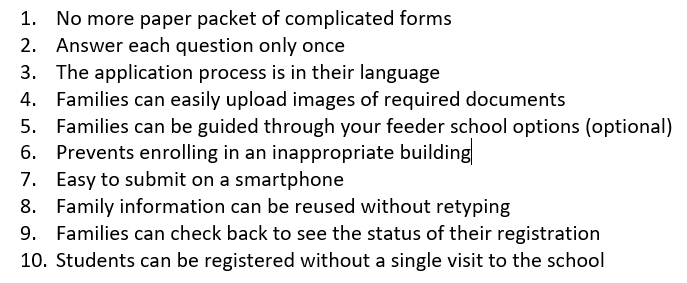
When a district builds coordination around this framework, families complete a single application — in their language, on their phone, with documents uploaded at submission rather than carried in by hand. Coordinators see a unified queue across all buildings, filterable by program, status, and school. No one is working from a separate spreadsheet. No application sits in limbo waiting for someone to remember it.
For oversubscribed UPK programs, New York State requires a documented random selection lottery under Commissioner’s Regulations §151-1.4(d) — and results cannot be adjusted for any demographic. An auditable system lottery doesn’t just satisfy that requirement. It’s how you prove compliance when a family asks, or a regulator does.
When a seat opens, the next eligible student on the waitlist is moved automatically. Staff have purpose-built communication tools to keep families informed at every stage — so families aren’t left waiting in silence wondering where things stand. And every action, every note, every status change is time-stamped and logged. When a question arises from a family, a supervisor, or an OCR civil-rights review, the gap between your SIS and your registrar is exactly where the answer needs to live — and with RightPath™ Welcome Center, it does.
THE DISTINCTION THAT MATTERS
This is a coordination and documentation problem. The SIS stores final student records. RightPath™ Welcome Center handles everything that happens before those records exist — the intake, the review, the selection, the communication, and the audit trail. These systems are complementary. The gap between them is exactly where program coordination breaks down.
Questions Worth Asking Before Your Next Enrollment Cycle
If any of these land close to home, your coordination process may be working against you:
- Are applications coming in through more than one channel?
- Does one person hold the master count of available seats — or worse, are multiple people maintaining separate counts with no coordination between them, and nobody knows which number is right?
- Can you produce a documented, auditable record of how placements were made?
- When a family asks why wasn’t our child selected? — what do you tell them?
- If your UPK program is oversubscribed, can you prove the lottery was random and unadjusted — as New York requires?
- Does a student’s application connect to their graduation pathway?
- What ensures a Year 1 CTE student gets their Year 2 seat — and doesn’t lose the 4+1 endorsement?
- If enrollment doubled next year, could your current process handle it?
These aren’t hypotheticals. They’re the operational realities in most districts — not signs of failure, but signals that the tools aren’t keeping up with the work.
The Bottom Line
The districts that manage this well aren’t the ones with the most coordinators or the biggest budgets. They’re the ones that stopped running a multi-building, multi-program operation through disconnected spreadsheets and individual memory — and built infrastructure that makes coordination visible, selection defensible, and compliance documented. Your SIS wasn’t designed for this either. It stores the result of enrollment — the final, verified student record. It was never built to manage the process that produces it. That process needs its own home.
If program coordination feels harder than it should, we’d like to show you what it looks like when the process is actually designed for the work.
RightPath™ Welcome Center was built for exactly this problem.
Our Welcome Center module gives your coordinators a purpose-built workflow — program-specific applications, centralized queue across buildings, transparent closed lottery, automated waitlist management, and a complete audit trail. Because coordination that runs on heroics isn’t a strategy. It’s a liability.
Register for a 15-Minute Discovery Session →
Related: The Gap Between Your SIS and Your Registrar →
Also Read: 5 Signs Your Registration Process Is Due for an Upgrade →