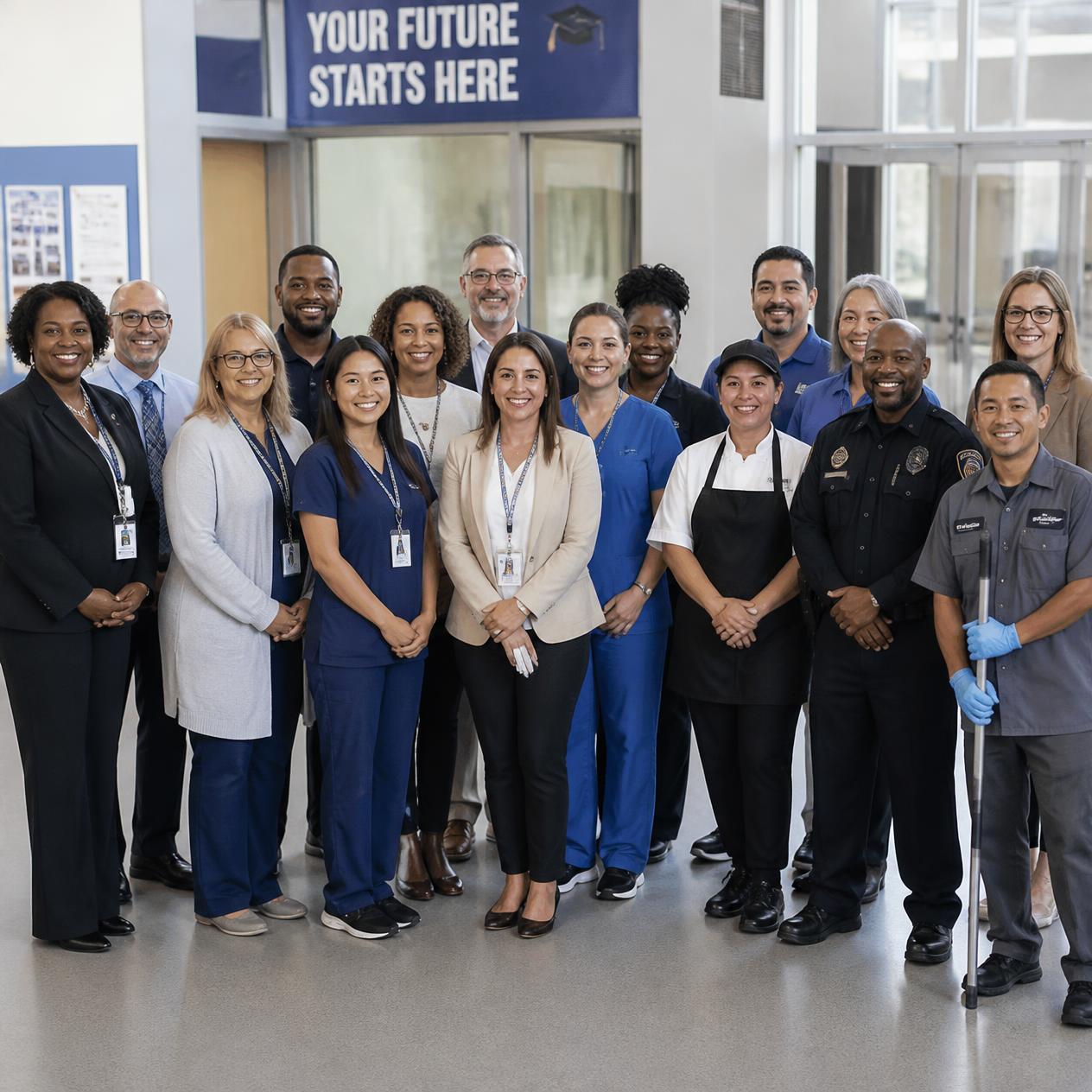
Most evaluation platforms cover about 40% of your staff. Bus drivers, nurses, cafeteria teams, custodians, clerical staff — the people who make up the majority of a district’s workforce — are often left out of any real evaluation system entirely, tracked (if at all) in spreadsheets and paper files that never talk to each other.
A student’s educational experience isn’t built by educators alone; it’s the whole learning community.
If your district’s evaluation strategy stops at teachers and principals, it’s only accounting for a minority of the people responsible for that student’s day.
Two Paths to Complete Evaluation
Every district employee falls into one of two paths, and they work very differently:
- Certified Educators — teaching staff and administration. Their evaluation is governed by Education Law 3012-e (STEPS), a specific state-defined framework.
- Support Staff — every other role in the district, evaluated appropriately by role, through processes your district designs itself.
Both paths need to happen well. Only one of them is dictated by Albany.
Role-Appropriate by Design
Support staff evaluation isn’t one template stretched across ten different jobs — each role has its own focus and its own level of day-to-day contact with students:
| Role | Role-Specific Focus | Student Contact |
|---|---|---|
| Guidance / Counselors | Student support planning, college & career readiness, caseload management, crisis response protocol | Frequent — trust-based, often a student’s primary confidant |
| Nursing Services | Clinical protocol adherence, medication administration, documentation, emergency readiness | Frequent — need-based, builds trust in vulnerable moments |
| Psychologists | Assessment & evaluation accuracy, IEP/504 collaboration, crisis intervention | Frequent — high-trust, sensitive interactions |
| Transportation | Safe/on-time routes, certification currency, student management | Frequent — daily, unsupervised, sets first/last tone of the day |
| Technology / IT Support | System uptime, helpdesk response time, classroom device & software support | Incidental — enables instruction indirectly |
| Building & Maintenance | Safety compliance, preventive maintenance, work-order response time | Incidental — models respect in shared spaces |
| Human Resources | Hiring & onboarding quality, compliance & recordkeeping, staff support responsiveness | Minimal — shapes culture through staff experience |
Guidance counselors, nurses, and psychologists have frequent, high-trust student contact and need to be evaluated on that reality. IT support and HR have real jobs to do — just not ones best measured the same way.
The Universal Foundation
Every rubric can still start from the same place. Reflecting the standard NY civil service performance-rating structure under Civil Service Law Section 140, every role — regardless of job title — can be evaluated on four shared basics before any role-specific criteria are added:
- Attendance & Punctuality — present and on time, every shift, as scheduled
- Interpersonal Conduct & Teamwork — works cooperatively with coworkers and supervisors
- Professional Appearance & Conduct — meets dress code and conduct standards for the role
- Following Direction & Task Focus — completes assigned duties as instructed; stays on task
Every role gets this same foundation. What’s role-specific comes next.
Different Roles Need Different Evaluators, Too
A principal can fairly judge a paraprofessional’s classroom support — but not a nurse’s clinical judgment. New York Education Law Section 6902 — part of the Nurse Practice Act (Article 139) — specifies that only certain licensed health professionals (a physician, nurse practitioner, midwife, podiatrist, dentist, clinical nurse specialist, or another registered nurse) may supervise the clinical nursing practice of an RN or LPN. A building administrator can evaluate the non-clinical parts of the role — punctuality, documentation habits, how a nurse communicates with families — but the law doesn’t permit that same administrator to supervise or evaluate the clinical judgment behind a nurse’s decisions.
Most one-size-fits-all systems can’t manage evaluations that way.
RightPath™ can.
Every Role Matters.
One Often Makes Headlines.
You’ve just seen what role-appropriate evaluation looks like for the 60% of your staff most platforms ignore.
Now, the other side of the house — the educators everyone’s watching closely.
Less Compliance. More Leadership. That’s 3012-e.
For teachers and principals — the roles that do fall under STEPS — there’s genuinely good news. APPR isn’t disappearing; it’s evolving into STEPS, the Standards-based Educator Evaluation and Professional Support System. Educator evaluation is still required, evaluation method options have increased, and multi-year cycles are now permitted for non-probationary educators. Districts have time: STEPS plan conversion isn’t required to be completed until 2032. Evaluation is no longer just observations and test scores — portfolios, surveys and feedback, and projects are all on the table, and districts design their own additional measures, with NYSED offering sample measures districts can draw from if they choose.
That flexibility is also what makes STEPS more complex to administer than 3012-d ever was: STEPS plan agreements take time to negotiate, evaluation plans must map to the NYS Teaching Standards or PSELs (and those standards can vary year to year within a cycle), and staggered cycles mean tracking requirements across multiple years at once. Districts are also working with an entirely new rating process and new weighting and score types — all locally negotiated, bargained with your unions, not dictated by Albany. The one piece that isn’t locally negotiable is the reporting format: NYSED prescribes the form and manner in which districts must submit ratings to the state. All educators will have standard-level ratings reported to NYSED every year; only probationary educators will have an overall score reported every year.
RightPath™ already supports many of STEPS’s required changes — some districts have already begun the conversion, and we already support evidence document management, with expansion underway to cover new evaluation methods as districts adopt them.
What “Efficient” Actually Requires From a Platform
Covering every staff type efficiently — STEPS-governed and locally-governed alike — means a platform needs to handle, simultaneously:
- A universal foundation layer for every role, plus role-specific criteria on top of it
- Multiple observation types — formal, informal, self-evaluation, pre- or post-conference, and end-of-year scoring
- Rubric flexibility — established educator rubrics (Danielson, NYSUT, Marshall, MPPR) alongside custom rubric creation for non-teaching staff and new STEPS-aligned rubrics
- Multiple and shared observers, so a nurse supervisor, an HR director, and a building principal can each evaluate the roles they’re actually qualified to assess
- Role-based access — edit, read-only, or no access, matched to who should see what across every staff category
- A historical repository and document storage for evidence and portfolios, searchable across staff type and year
- STEPS-compliant reporting for teachers and principals specifically, without forcing that same rigid format onto staff types it was never designed for
The Bottom Line
Every role matters. One often makes headlines. Student success depends on far more people than the ones standing in front of a classroom — and evaluating that whole learning community well means recognizing that teachers and principals fall under a specific, state-defined framework, while everyone else falls under a framework your district builds itself. Both need to happen efficiently, on the same platform, without forcing one group’s rules onto another.
RightPath™ evaluates everyone — on one platform.
RightPath already supports non-educator staff evaluation alongside STEPS-compliant teacher and administrator evaluation — with multi-year cycle scheduling, per-standard scoring, custom rubric creation, and document storage for evidence and portfolios, all on the same dashboard. We’ve supported NY districts through every evolution of APPR, and we’re ready to help you build an evaluation process that covers everyone who makes your district work.
Register for a Webinar →
Schedule a Free Consultation →
Next: Educator Evaluation Isn’t Going Away. APPR (3012-d) Is →