School district registration season arrives the same way every year — but it doesn’t feel the same in every district. In some offices, it hums along. Applications come in online, documents are uploaded and reviewed, and staff have the breathing room to actually connect with new families rather than chase missing paperwork. In others, it’s controlled chaos: phones ringing nonstop, families standing in line feeling confused or unwelcome, stacks of incomplete forms piling up, and registrars stretched far past capacity. The difference between those two experiences rarely comes down to effort. It almost always comes down to process.
If your district’s enrollment period feels more like the second scenario than the first, it may be time to take an honest look at your process. Here are five signs that your registration experience — for families and for staff — is ready for an upgrade.
1. Your Phone Lines Light Up Every Time Registration Opens
When a registration process is clear, intuitive, and accessible, families can complete it on their own without needing to call the school for help. When the phones start ringing off the hook the moment the enrollment window opens, that’s a signal your process has gaps.
Common culprits include:
- Paper forms that need to be filled out, scanned and uploaded or dropped off
- Instructions that are confusing or buried in a PDF families have to find and download
- A portal that doesn’t work properly on a smartphone
- Form fields that aren’t labeled clearly, leaving families unsure what’s being asked
- No way to save progress and return later — forcing families to complete everything in one sitting
- Error messages that don’t explain what went wrong or how to fix it
Each one of those phone calls represents a family who was willing to try the online process but couldn’t complete it. That’s not a family problem — it’s a design problem. And every call your staff has to take during peak registration season is time they’re not spending on higher-value work.
Ask yourself: If you removed the phone option entirely, how many families could successfully enroll without assistance? The answer tells you a lot about the quality of your current experience.
2. Families Who Don’t Speak English Are Falling Through the Cracks
Walk through your district’s enrollment portal right now and ask: what does this experience look like for a family whose primary language is Spanish? Or Haitian Creole? Or Arabic? Or Mandarin?
If the answer is “pretty much the same, just harder,” your registration process is creating barriers for some of your most important families — often the very families who may have the most to gain from the programs you offer.
The downstream effects of a language-inaccessible registration process are significant:
- Families submit incorrect or incomplete information because they misunderstood the questions
- Notification emails — about missing documents, lottery results, deadlines — go unread or misunderstood
- Older siblings are pulled into translating for parents, an unfair and unreliable workaround
- Families disengage entirely, meaning children miss out on programs they’re entitled to participate in
Federal and state equity requirements exist for a reason. A registration process that only functions well for English-speaking families is not meeting the needs — or the legal obligations — of a diverse community. Language access in registration isn’t a luxury add-on. It’s a fundamental part of welcoming every family equally.
3. You’re Still Trusting Handwritten Forms to Capture Critical Family Data
Ask any experienced registrar what the worst part of paper-based enrollment is, and you’ll likely hear some version of the same answer: you can’t read half of what families write. An address that’s missing an apartment number. A date of birth that looks like it could be a 3 or an 8. An emergency contact phone number with a digit that might be smudged. An immunization date that’s illegible.
These aren’t minor inconveniences. Inaccurate student data creates real problems — from families not receiving critical communications, to health records that don’t match what a nurse actually needs in an emergency, to state reporting figures that don’t hold up under scrutiny.
Beyond legibility, paper forms have another significant data quality problem: they’re filled out in a hurry, in a waiting room, often by someone who isn’t sure what they’re being asked. Fields get skipped. Questions get misunderstood. Required information is missing and nobody catches it until a staff member sits down to manually process the form days later.
A well-designed digital registration form addresses this at the point of entry:
- Required fields are enforced — a family simply cannot submit an incomplete application
- Address fields are formatted and validated as families type, catching errors immediately
- Date fields use selectors that eliminate ambiguous handwriting entirely
- Conditional logic means families only see questions relevant to their situation — reducing confusion and irrelevant blanks
- Uploaded documents — birth certificates, proof of residency, immunization records — are legible, stored securely, and retrievable by authorized staff in seconds
There’s a practical upside to moving registration online that doesn’t get talked about enough. A well-designed registration platform isn’t just a front door for applications — it becomes a system of record in its own right. Think about the volume of documentation a district collects during enrollment: proof of residency, birth certificates, immunization records, custody agreements, court orders, household language surveys, McKinney-Vento status disclosures, program-specific consent forms. Not all of it needs to live in your Student Management System in full detail. In many cases, the SMS needs only a summary flag — “residency verified,” “McKinney-Vento eligible,” “custody restriction on file” — while the actual supporting documents are stored securely and retrievably within the registration platform itself. That’s the right home for that data: organized, searchable, and accessible to the staff who need it, without cluttering the SMS with attachments it was never designed to manage or leaving critical compliance documentation buried in a filing cabinet.
There’s a confidentiality dimension here too. Sensitive documents — custody agreements, court orders, immigration-related residency proofs, health-related consent forms — carry real obligations under FERPA and in some cases HIPAA. A dedicated registration platform with role-based access controls gives districts far greater ability to govern who can see what, and to maintain an audit trail of who accessed sensitive records and when. Spreading that same documentation across an SMS that dozens of staff log into daily, or keeping it in paper files with no access log at all, creates exposure that a well-designed registration system is built to prevent. Keeping sensitive enrollment documentation where it belongs isn’t just operationally smart — it’s the defensible choice.
A well-run registration platform doesn’t hand everything off the moment enrollment is complete. It remains a living reference for the enrollment record throughout the year.
When the data is clean and organized at the point of collection, your staff spend their time making decisions and communicating with families — not deciphering handwriting or calling parents to fill in fields that should never have been left blank.
4. Your Lottery or Program Choice Process Creates More Questions Than Answers
Across New York State and elsewhere, many districts run lotteries for oversubscribed programs — Universal Pre-K, STEAM academies, CTE pathways, BOCES programs, and magnet schools among them. By law and by principle, those lotteries must be random and fair. But “random and fair” isn’t enough if families don’t trust the process.
Lotteries that are run through spreadsheets, pulled from a hat, or managed through a generic online randomizer tool invite exactly the kind of scrutiny districts want to avoid. When a family’s child doesn’t receive a seat, they ask questions — and they should. The integrity of the process needs to be defensible, transparent, and documented.
Signs your lottery process needs work:
- You can’t easily produce a documented audit trail of how the lottery was conducted
- Families receive only a yes or no — no waitlist position, no timeline for what happens next
- When seats become available due to declines, staff manually contacts families one by one
- Applying to multiple programs requires families to complete separate applications in separate places
- Your process has no systematic way to apply weighting priorities — for siblings, income eligibility, merit or other district-defined criteria — while maintaining fairness
A purpose-built lottery system handles all of this automatically and transparently. Families can see their waitlist position. Staff can document every placement decision. And when someone asks “how was the lottery run?” — you have a clear, defensible answer. Public trust in your process is worth protecting. The right tools make that easy.
5. New Families Arrive Feeling Confused — Not Welcomed
This one is harder to measure but easy to feel. Talk to the families who enrolled in your district in the last year. Ask them what the registration process was like. Did it feel organized? Did they know what was expected of them? Did they feel like the district was glad they were there?
Or did they feel like they were navigating a bureaucratic obstacle course on their own?
The registration experience is often a family’s very first interaction with your district. Before they meet a teacher, before they see the classroom, before any of the good work your educators do every day — they experience your enrollment process. That experience shapes their expectations and their trust.
Districts that have transformed their registration offices into genuine Welcome Centers — whether physical, digital, or both — report a noticeable shift in how new families engage. When the process is clear, respectful, multilingual, and accessible from any device, families arrive on day one already feeling like they belong. That’s not a small thing. That’s the foundation of a school-family partnership that will last for years.
So What Does an Upgraded Registration Process Actually Look Like?
If any of these five signs hit close to home, the good news is that the path forward is well-established. Districts that have modernized their enrollment process share a few things in common:
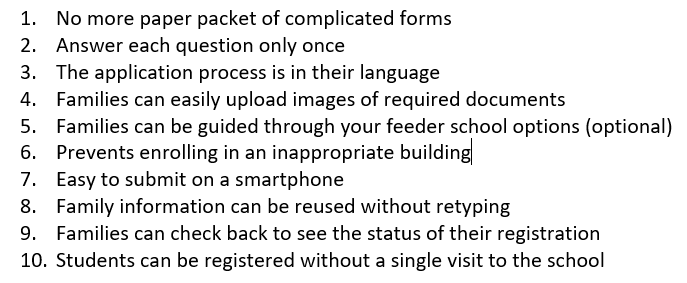
- Mobile-first design — registration that works beautifully on a smartphone because that’s how most families will access it
- Multilingual support — forms, instructions, and family communications available in the languages your community actually speaks
- Intelligent workflow tools for staff — applications queued by status, side-by-side document review, templated communications, and automatic waitlist management
- Transparent, auditable lottery management — purpose-built for program choice, equitable by design, and defensible when questions arise
- Clean data from the start — digital forms with required fields, validation, and document uploads that eliminate the legibility and completeness problems that plague paper-based enrollment
- Registration as a system of record — a dedicated platform that securely stores enrollment data, compliance documentation, uploaded files, and family communications in one organized, searchable place — reducing the volume of data that needs to flow elsewhere
At Right Reason Technologies, we built our RightPath™ Welcome Center module specifically to help districts get there — without requiring a massive IT project or a complete overhaul of your existing systems. A dedicated registration platform can serve as a powerful system of record for your enrollment process — capturing clean, complete, validated family data from the moment a family first applies, and keeping it organized and accessible throughout the school year and beyond. Whether you’re starting with registration, adding program choice, or ready to implement a full lottery management solution, we can meet you where you are and help you build toward the experience your families deserve.
Because every family that walks — or logs — into your district for the first time should feel one thing above all else: welcome.
Want to see what a modernized registration experience looks like in practice? Join one of our upcoming webinars or schedule a free 15-minute conversation with our team. We’re educators, trainers, and technology professionals — and we’re here to help you navigate the path to success.
Join a Webinar
Schedule a Free Consultation
Learn More About RightPath™ Welcome Center
Continue Reading →
Next: From Frustrating to Friendly: Why Your District’s Registration Process Sets the Tone for Everything That Follows